


August 7, 2018
2018 Substantial Similarity Update Available
The 2018 annual supplement to our treatise Substantial Similarity in Copyright Law is now available from PLI.
August 7, 2018
Practical Law Update Completed
Eric Osterberg’s article Copyright Infringement: Analyzing Substantial Similarity in Westlaw’s
Practical Law has recently been updated.
January 6, 2017
In-House Patent Lawyers Can Design Around Patents They Wrote For Their Former Employer
In house lawyers, even patent lawyers, can jump to a competitor, as long as they don’t violate duties owed to their former employer/client. Furthermore, patent lawyers are free to conduct for their new employer infringement analyses of patents they wrote for their former employer. That is the holding in a 2016 Massachusetts case, Gillette Co. v. Provost. The court wrote: “It is perfectly lawful for Gillette’s former patent attorney to help a competitor avoid infringing Gillette patents, so long as he does not disclose or use any confidential information obtained from Gillette.”
The lawyer in question worked for a number of years as an in-house patent attorney for Gillette. He then took a job as General Counsel at ShaveLogic (Dollar Shave Club), where his job responsibilities included helping ShaveLogic design around patents he had prosecuted while at Gillette. Gillette sought an injunction preventing him from doing that work on the basis that the lawyer had breached the fiduciary duty a lawyer owes a former client under Massachusetts Rule of Professional Conduct 1.9. The rule prohibits a lawyer from representing a second client in the same or a substantially related matter in which the second client’s interests are materially adverse to the interests of the former client
The court held that the design-around work did not violate the rule because Gillette could not show that it involved misuse of Gillette’s confidential information; the wrong Rule 1.9 is designed to prevent. Patents are pubic documents, and opining on whether a particular product infringes a patent requires nothing more than comparing that product to the public patent. Confidential information could not help. The court explained that if the in-house lawyer’s new job had involved assessing the validity of patents he prosecuted at Gillette, the result might have been different. In that circumstance the lawyer might have confidential information concerning prior art or inventor behavior that would aid his analysis.
December 21, 2016
SaaS Providers – What Exactly Is Your Business?
Is a SaaS provider’s business making software, or performing the service the software automates? If you are a SaaS provider (or a lawyer who represents SaaS providers and licensees) you will likely answer: both. It’s Software as a Service, dummy.
Not so fast, at least not in the trademark world. Recent events involving the SaaS provider JobDiva in the USPTO and the Federal Circuit reveal that the answer may not be both in every instance. Whether a SaaS provider can establish trademark rights in both categories depends on whether the provider can demonstrate that a user would associate the trademark with the service performed by the software, as opposed to just the software. In other words, the question is whether the provider’s use of its marks creates in the minds of purchasers an association between the mark and the services, as opposed to just the software.
JobDiva makes software that automates certain aspects of the recruiting process. The Federal Circuit described JobDiva’s business as follows:
JobDiva’s software generally provides a database of employment applications that a hiring manager or recruiter might use to fill a job opening. The software performs multiple functions to facilitate this job filling process. It employs automated “harvesters” to find potential job candidates by automatically scraping job boards and aggregating relevant resumes. And it reviews and analyzes job candidates’ resumes to determine if any candidate’s qualifications match the job’s requirements. It thus “replaces a tedious manual search” previously performed by hiring managers or recruiters. JobDiva also helps hiring managers directly communicate with job candidates. For instance, it permits hiring managers to post job openings in a job candidate portal. This candidate portal may also be embedded into a company’s website. The software further assists job candidates by recommending potential openings to the candidates based on skillsets and provides them automated resume feedback.
JobDiva registered the word JOBDIVA as a trademark for both computer services and recruiting services. When it petitioned the USPTO to cancel rival JobVite’s trademark registration, JobVite counterclaimed for cancellation of the JOBDIVA mark for recruiting services. The Trademark Trial and Appeal Board (“TTAB”) cancelled the registration as it pertained to those services (leaving the mark intact for software). The TTAB reasoned that it was insufficient for JobDiva to offer software that performed personnel placement and recruitment functions. To be engaged in the recruiting business, as opposed to the software business, JobDiva would have to offer personnel placement and recruitment services in addition to providing software.
On appeal, the Federal Circuit disagreed and sent the case back to the TTAB for further consideration. The court held that what is required is a fact-intensive inquiry into likely consumer perception. “For example,” the court wrote:
in this case, the Board should consider the nature of the user’s interaction with JobDiva when using JobDiva’s software, as well as the location of the software host. If JobDiva sells its software to a customer who hosts the software on its own website and a third-party user’s interactions appear to be with the customer (as opposed to JobDiva), it is unlikely that the customer or the third-party user would associate the JOBDIVA mark with a service performed by JobDiva. But if the software is hosted on JobDiva’s website such that the user perceives direct interaction with JobDiva during operation of the software, a user might well associate JobDiva’s marks with personnel “placement and recruitment” services performed by JobDiva.
So, the important question seems to be: what services do your customers think you provide?
September 1, 2016
Arbitration: Everything You Promised, Nothing You Didn’t
If you agree to arbitrate with a particular arbitrator, but that arbitrator won’t serve, you go to court. That is the teaching of a recent case out of the Second Circuit, Moss v. First Premier Bank. In Deborah Moss’ online contract with her payday lender she agreed to arbitrate any dispute using NAF as the arbitrator. When Moss wanted to bring a claim against the payday lender’s banking partner, NAF could not serve as the arbitrator because NAF had entered into a consent degree with the Minnesota Attorney General prohibiting it from arbitrating consumer disputes. The bank wanted to require Moss to arbitrate before a different arbitrator, reasoning that the parties had agreed to arbitrate, so if the chosen arbitrator wasn’t available, they should pick another. “Not so fast” said the district court, and then the Second Circuit. Moss only agreed to arbitrate with NAF, not anyone else. If NAF is unavailable, she can sue. She can’t be forced to choose someone else. Although there is a general policy favoring arbitration, arbitration agreements are contracts and courts can’t rewrite contracts to change the parties’ agreement. The Second Circuit noted that other Circuits (the Seventh and Third) have reached contrary results.
If you really want to arbitrate regardless of the arbitrator, either don’t identify the arbitrator in the contract or, if you do, agree to choose another if your first choice is unavailable. If you’d rather go to court than pick another arbitrator, specify the arbitrator you want in your contract.
April 19, 2016
Spirit v. Led Zeppelin, Taurus v. Stairway To Heaven
The copyright infringement lawsuit accusing Led Zeppelin of plagiarizing the song Taurus in the iconic Stairway to Heaven just got really interesting because the judge denied (in part, but in the most important part) defendants’ motion for summary judgment, and whether the songs are “substantially similar” seems like it may be a close call. If they end up with a jury like the one in the Marvin Gaye Estate lawsuit against Pharrell Williams, in which the jury ruled that Blurred Lines infringed Got to Give It Up, the case may go badly for the defendants. Here are links to some material that may help you decide for yourself.
Recordings of both songs – http://www.musicradar.com/news/guitars/led-zeppelin-to-face-jury-trial-over-stairway-to-heavens-substantial-similarity-to-spirits-taurus-636913
Guitar analysis by TJR – https://www.youtube.com/watch?v=PCEg9gMJakU
Opinion denying (in part) motion for summary judgment – http://www.jurisnote.com/Case/zep346.pdf
July 7, 2015
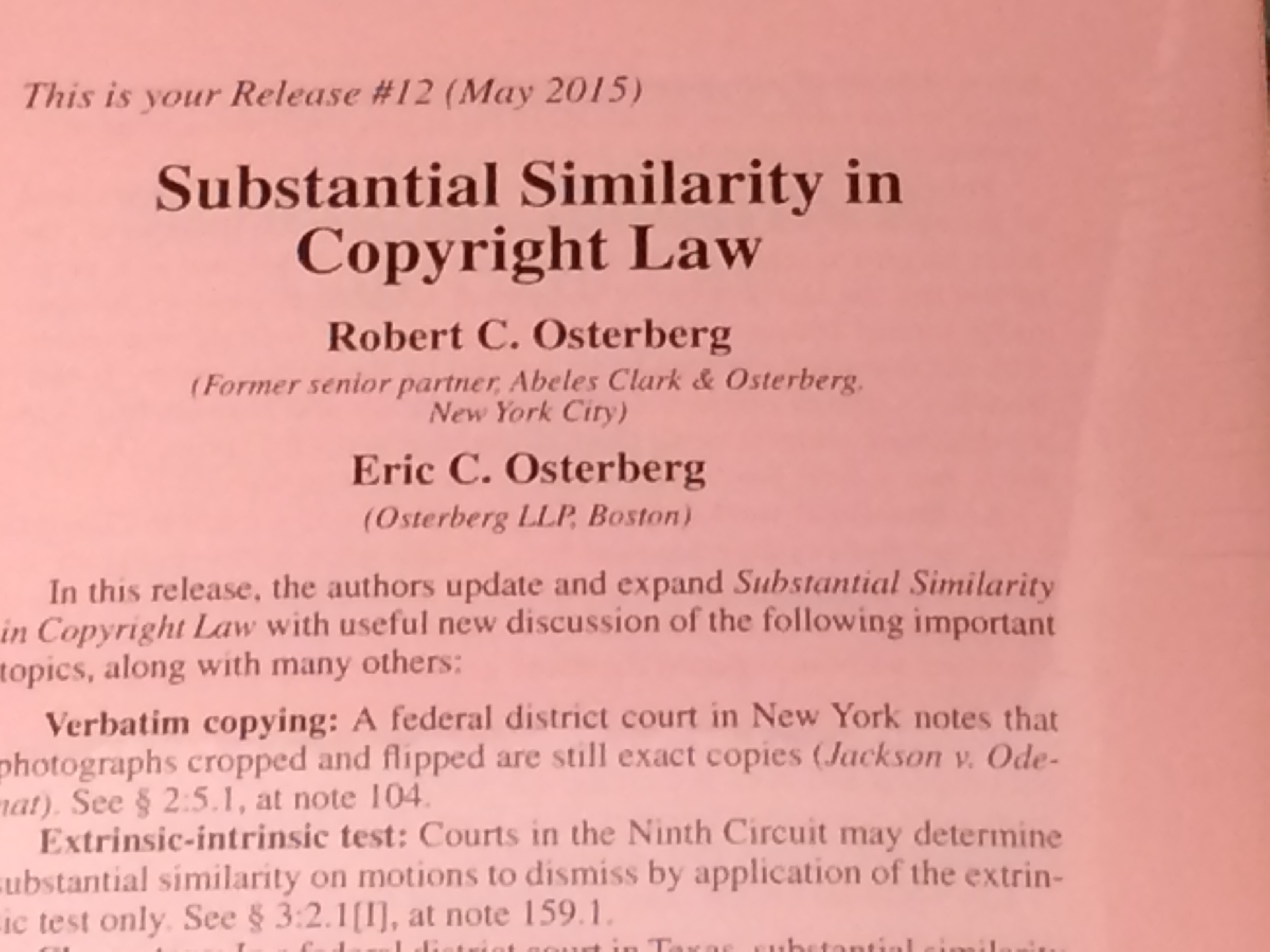
2015 Substantial Similarity in Copyright Law Supplement Available
The 2015 annual supplement to our treatise Substantial Similarity in Copyright Law is now available from PLI.
May 18, 2015
The Government Can’t Take Your Copyright
A little known and infrequently invoked feature of the U.S. Copyright Law is its prohibition against government-mandated copyright transfer from an individual author. 17 U.S.C. § 201(e) reads:
When an individual author’s ownership of a copyright, or of any of the exclusive rights under a copyright, has not previously been transferred voluntarily by that individual author, no action by any governmental body or other official or organization purporting to seize, expropriate, transfer, or exercise rights of ownership with respect to the copyright, or any of the exclusive rights under a copyright, shall be given effect under this title, except as provided under title 11 [the bankruptcy code].
Even a court cannot order a transfer. In a recent case in the District of Massachusetts, the court held that the effect of § 201(e) was to void a court ordered transfer from the defendant to the plaintiff.
May 4, 2015
Clickwraps and Browsewraps: What’s the Difference?
Clickwrap and browsewrap agreements are documents typically used by website owners to mandate the terms on which users may access their websites. The difference between the two is the manner in which the user agrees to the terms. Clickwrap agreements require an overt act of consent by the user. Typically, the user must click a button to signify acceptance. Browsewrap agreements do not require any overt consent. Rather, the website owner posts the terms of use on the site and asks that users not access the site unless they agree to those terms.
Courts treat the two differently because of the difference in the manner in which the user accepts the terms. Clickwrap agreements are generally enforceable because the user’s click is an affirmative act indicating acceptance. The enforceability of browsewrap agreements depends on the prominence of the browsewrap terms. The more prominently the terms are displayed, the more likely a court will rule that users are bound because they must have seen the terms (or deliberately ignored them) and therefore a user’s continued use of the site demonstrates consent to the terms.
November 4, 2014
Copyright Fair Use – Is “Transformativeness” The Key?
Fair use is a statutory defense to copyright infringement. The fair use statute, 17 U.S.C. § 107, suggests certain types of uses that generally may qualify as fair use, and identifies four factors a court must consider to decide when any particular use qualifies. The statute reads as follows:
Notwithstanding the provisions of sections 106 and 106A, the fair use of a copyrighted work, including such use by reproduction in copies or phonorecords or by any other means specified by that section, for purposes such as criticism, comment, news reporting, teaching (including multiple copies for classroom use), scholarship, or research, is not an infringement of copyright. In determining whether the use made of a work in any particular case is a fair use the factors to be considered shall include—
(1) the purpose and character of the use, including whether such use is of a commercial nature or is for nonprofit educational purposes;
(2) the nature of the copyrighted work;
(3) the amount and substantiality of the portion used in relation to the copyrighted work as a whole; and
(4) the effect of the use upon the potential market for or value of the copyrighted work.
Until recently, case law identified the fourth factor, the effect of the use on the potential market for the original work, as the most important. But in a 2012 case, Cariou v. Prince, the Second Circuit arguably shifted emphasis to the first factor, and particularly whether the new use qualified as “transformative” .
Cariou is a professional photographer who published an anthology of photographs of Rastafarians. Years later, the self-styled “appropriation artist” Prince, copied Cariou’s photographs and altered them to varying degrees to create a series of works of his own. The alterations ranged from wholesale changes that left Cariou’s images barely recognizable to mere pasting of colored ellipses over the subjects’ eyes. The district court found Prince guilty of copyright infringement ,but the Second Circuit reversed. The most significant factor in the Second Circuit’s decision was the court’s finding that many of Prince’s works were undoubtedly “transformative”, defined as “add[ing] something new, with a further purpose or different character.” The Second Circuit held that a number of the Prince works “manifest an entirely different aesthetic from Cariou’s photographs.”
A recent decision from the Seventh Circuit, however, suggests that emphasis on “transformativeness” may not take hold elsewhere. In Kienitz v. Sconnie Nation the Seventh Circuit pointed out that the Second Circuit approach risks interfering with one of the rights the Copyright Law grants to copyright owners: the exclusive right to create derivative works. Derivative work is defined in the Copyright Act as “a work based upon one or more preexisting works, such as a translation, musical arrangement, dramatization, fictionalization, motion picture version, sound recording, art reproduction, abridgment, condensation, or any other form in which a work may be recast, transformed, or adapted.” The Seventh Circuit asked, basically: what else is a derivative work but a transformative use of an existing work? The court wrote: “We’re skeptical of Cariou ‘s approach, because asking exclusively whether something is “transformative” not only replaces the list in § 107 but also could override 17 U.S.C. § 106(2), which protects derivative works. To say that a new use transforms the work is precisely to say that it is derivative and thus, one might suppose, protected under § 106(2). Cariou and its predecessors in the Second Circuit do not explain how every “transformative use” can be “fair use” without extinguishing the author’s rights under § 106(2). We think it best to stick with the statutory list, of which the most important usually is the fourth (market effect).”
These recent cases should cause parties analyzing their likelihood of success on a fair use defense to consider most carefully how they think they will fare on the first factor (purpose and character of the use, the factor in which courts consider whether a work is transformative) and the fourth factor (effect on the market). Once they decide that, they may then seek to gain advantage by steering their case to, or away from, the Second Circuit and its emphasis on “transformativeness.”